
Laparoscopic Surgery
Minimally invasive neutering. 60% less pain, faster recovery.
About this specialization
Laparoscopic surgery is the gold standard of minimally invasive procedures. Its gentle approach allows surgery to be performed through smaller incisions, which brings patients several advantages over the conventional surgical approach.
In a laparoscopic spay the incisions are smaller, the anaesthesia shorter and the post-operative period involves considerably less pain. The patient can return to normal life sooner. The minimally invasive approach is therefore an important part of modern surgical care in our hospital.
What it includes
- 60% less pain than the conventional method
- Faster recovery
- Smaller incisions, fewer risks
- Laparoscopic spaying of dogs and cats
Gallery
Articles on this topic
Frequently asked questions
Is laparoscopic spaying safe?
Yes — laparoscopy is safer than the conventional method. Smaller incisions mean a lower risk of infection, less blood loss and shorter anaesthesia.
How does it differ from a conventional spay?
A conventional spay needs a 5–10 cm incision in the abdomen. Laparoscopy needs only 2–3 small ports (5–10 mm). The result is 60% less pain, faster recovery and a lower risk of complications.
When will my animal be back to normal?
Most animals are active again the day after the procedure. Full recovery usually takes 5–7 days, compared with 10–14 days for the conventional method.
Is laparoscopy suitable for cats too?
Yes — we perform laparoscopic spays on dogs and cats of all sizes. A pre-operative examination including blood tests is required before the procedure.
How much does a laparoscopic spay for a dog or cat cost?
The price varies depending on the individual patient, so we cannot give a single figure. We will gladly prepare an exact quote in person: visit us at Lamačská cesta 53 in Bratislava or call 0907 824 196.
How is a laparoscopic spay of a female dog carried out?
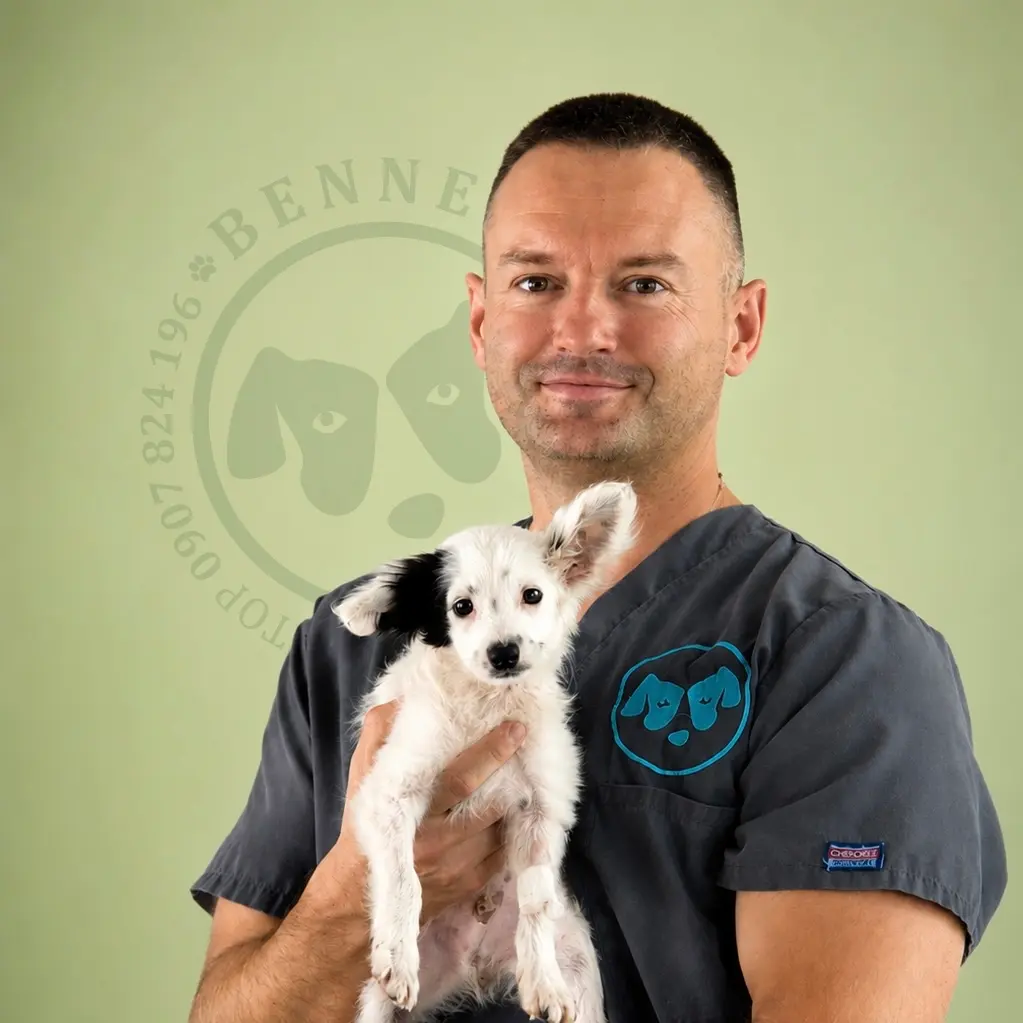
A pre-operative examination including blood tests is required before the procedure. MVDr. Martin Lapin then performs it laparoscopically through 2–3 small ports (5–10 mm) instead of a 5–10 cm incision. Most animals are active again the day after.
How do I book a spay?
Visits must be booked in advance. Call us on 0907 824 196 (every day 08:00–20:00) or register a new patient online.
Book an examination
Call us and we'll schedule an appointment.This area is led by MVDr. Martin Lapin.